

Chicago West Suburbs · Investor Intelligence · 2026
9 min read · Updated June 2026 · For Landlords & Investors
The conversation about Chicago real estate has been dominated by Logan Square lofts and West Loop condos. But the investors quietly building the most durable portfolios? Many of them are heading west — to DuPage and Cook County’s western belt, where school districts anchor tenants for years, Metra lines keep commuters paying premium rents, and entry prices still make the math work.


Why the Suburbs — and Why Now?
The suburban play isn’t new. But the current setup is unusually strong. According to Essex Realty Group, the Chicago suburban rental market is competing with Miami and New York for the most competitive rental market in the country. Rent growth across the Chicago metro’s suburbs is projected at 3–4% year-over-year through 2026, and institutional capital that historically avoided suburban Illinois is starting to show up.
The structural argument is simple: city rents have run hard. As the Chicago metro’s average rent approaches $2,160/month and city property taxes pile on, suburban markets offer a genuine spread between acquisition cost and rental income that increasingly doesn’t exist inside city limits. Throw in longer average tenancies, lower regulatory risk, and — in DuPage County — no rental licensing requirements in most municipalities, and the risk-adjusted case for the west suburbs is compelling.
What we mean by “West Suburbs”: This analysis covers the western arc from Oak Park and Berwyn (near-Cook, adjacent to city limits) through Elmhurst, Lombard, and Wheaton (mid-DuPage), out to Naperville, Downers Grove, and Bolingbrook (outer DuPage / Will County). All are served by Metra’s BNSF, UP-W, or Heritage Corridor lines.

The Suburb-by-Suburb Breakdown
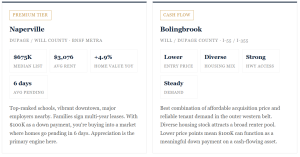
Not all western suburbs are built the same for investors. Here are the six markets worth your attention — each with a different risk profile, entry point, and strategy fit.


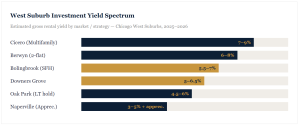
Three Ways to Deploy $100K in the West Suburbs
Your capital structure shapes everything. Here’s how three distinct strategies map onto the west suburb opportunity — each with a different risk profile and time horizon.


The Numbers That Make the Case
A side-by-side comparison of the three main entry points:
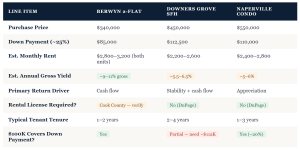
The suburbs don’t generate the same cocktail-party buzz as a West Loop condo. But they generate something more useful: tenants who stay for years, school-district anchored demand, and cash-on-cash returns that pencil out without financial engineering.
The Metra Premium — Don’t Overlook It
One of the most consistent findings across the west suburb market: proximity to a Metra station is the single most reliable driver of rental premium and low vacancy in this corridor. Properties within walking distance of stations on the BNSF, UP-W, and Heritage Corridor lines consistently outperform comparable homes farther from transit.
The practical rule: model two comparable properties — one walkable to Metra, one not — and you’ll typically see a 10–15% rent premium on the transit-accessible unit, plus meaningfully faster lease-up. Station proximity deserves its own line in the underwriting spreadsheet.
The Macro Argument for Acting Now
The Chicago suburban multifamily market has begun attracting institutional capital that historically stayed on the coasts and in Sun Belt cities. As Essex Realty Group noted in early 2026, the Chicago suburbs are seeing new institutional entrants — a development that, historically, precedes the compression of cap rates and the repricing of assets that individual investors have been quietly buying for years.
The window between “this market is being discovered” and “this market is fully priced” is the best time to own real estate. In the Chicago west suburbs, that window appears to still be open — but institutional attention has a way of closing it faster than most investors expect.
Meanwhile, Chicago-area multifamily rent growth was up 4.6% year-over-year in Q3 2025 per CBRE, with an additional 3% projected for 2026 driven by the ongoing shortage in new construction.
The Bottom Line: How to Deploy Your $100K
There’s no single right answer — it depends on your timeline, operating capacity, and return objective. Here’s the framework:

Whichever strategy fits your situation, the core thesis is the same: the Chicago west suburbs in 2026 offer constrained rental supply, stable tenant demand anchored by school districts and transit, and acquisition prices that still produce real returns — before the institutional money fully reprices the market.
The investors who understand a market before the headlines do are the ones who look smart a few years from now.

This article is for informational purposes only and does not constitute financial, legal, or investment advice. All real estate investing involves risk, including potential loss of capital. Market data is sourced from CBRE, Fannie Mae, Zillow, Redfin, Essex Realty Group, GC Realty, and Illinois REALTORS® and reflects conditions as of mid-2026. Always conduct independent due diligence and consult qualified professionals before making investment decisions.